
 Cart is empty
12v, 24v Power issues
1. Are there any concerns I should know regarding voltage or powering equipment?
2. What kind of run time can I expect from a 9 volt battery or your #BAT-1 battery pack?
3. How quickly will my car's battery drain when mobile equipment is plugged into cigarette lighter?
4. Why is using a "regulated" power supply so important & how do I know if I have one?
5. Can I use rechargeable batteries with your equipment?
Q1: Are there any concerns I should know regarding voltage or powering equipment?
A1: Yes! It is absolutely critical that you properly use the correct power supply (regulated ac/dc transformer or battery pack) for your camera and/ or transmitter, receiver, etc.. Failure to do so may result in irreversible damage to- or complete failure of- your equipment. The two main causes of damage or failure are using improper polarity (direction in which the electricity current and signals flow) or using too much voltage.
We make it too easy for you to get the right stuff to power your equipment (most items include FREE power supplies of the correct type)- so please don't be a "do-it-your-selfer" when it comes to power. See below for more information on why a regulated power supply is so important.
Back to top-->
Q2: What kind of run time can I expect from a 9 volt battery or your #BAT-1 battery pack?
A2: It depends on what equipment you're running and what kind of power source you're using. Even though most of our CCD cameras can accept a typical 9 volt alkaline battery, the run time will be VERY LOW (about 30-45 minutes before the required voltage or output falls too low to give the camera adequate power drive and consumption). However, if you use our BAT-1 battery pack with 8 fresh AA alkalines- it can power most of our small cameras for over 24 hours. Connecting additional equipment, like a #TX-9100 transmitter, to the same battery pack (with a Y power adapter) will run both camera and transmitter for about 12-15 hours. Adding a microphone will affect run time only very slightly as its current requirements are only about 1/10 that of a camera or transmitter.
Use of our #BAT-AAA battery packs will provide up to 12 hours or so for a pinhole camera and 4-7 for most camera and transmitter combinations. *Warning: when using battery packs, you must put each battery in proper marked order. Otherwise, batteries will cause problems in performance and may even explode!
Back to top-->
Q3: How quickly will my car's battery drain when 'mobile' equipment is plugged into cigarette lighter?
A3: If your car, truck, van, etc. has a relatively new battery, it should be able to run a lot of this equipment for fairly long periods of time (up to a week or more). The average car battery is generally rated for 300-500 amps. Our average camera only draws 100mA of current (or 1/10 of one ampere per hour)- so a camera may run for week or more. A mobile 12 volt dc VCR or DVR generally uses between 1-1.5 amps and will therefore drain it much more quickly- but still be able to operate for a fairly long time. *TECH NOTE: An electronic device will only consume as much power as it needs and does not create an additional drain beyond that. So, if a device only draws 100mA and it is powered by a source supplying 500mA, 1000mA- it is not being "over-powered" (as long as the power supply has the proper voltage, polarity and connection). *Warning: Never use automotive power without a FUSED connection as it could be hazardous. Back to top-->
Q4: Why is using a "regulated" power supply so important & how do I know if I have one?
A4: If you intend to power low voltage DC equipment with AC (standard 110v in United States) wall current, you MUST use a regulated ac-dc transformer, also known as a power supply. Low voltage transformer boxes are all around us, powering telephone / answering equipment, computer accessories, and many other consumer electronics. A quality 12 volt dc regulated power supply puts out just 12 volts and no more. An UNREGULATED 12v dc power supply may actually (when tested on meter) be producing up to 25 volts or more! This will overdrive the circuitry in your electronic device and may cause instant failure or overheating. So, even though you have a few extra transformers laying around in a drawer- they probably don't have either: 1) the right polarity, 2) the truly correct voltage or 3) the proper plugs sizes for a nice tight fit and good signal.
And don't be fooled by buzzwords like "filtered output"- unless it specifically reads "REGULATED CURRENT"- it's an unregulated supply!
*WARNING: No warranty will be honored unless the proper power supply or battery pack was used- no exceptions and no sympathy!!
Back to top-->
Q5: Can I use rechargeable batteries with your equipment?
A5: You certainly can use rechargeable batteries. Nickel metal hydride batteries are always recommended over nickel cadmium (NI-CAD) due to the main weakness of ni-cads being "memory fade" which may result in their inability to take or hold a charge. Memory fade is irreversible and batteries with the condition must be replaced. *NOTE: Alkaline batteries in AA, AAA, C or D sizes produce 1.5 volts each. Their rechargeable equivalents produce only 1.2 volts each- so it will require more of them in series to produce the same voltage. 8 rechargeable batteries in our BAT-1 pack will produce 9.6 volts rather than 12 volts- which is ok for all of our miniature covert CCD cameras (but not enough voltage for some transmitters, receivers or Infrared cameras).
Many specialty battery stores are popping up and can be a good source for custom packs. There you can purchase 10 rechargeable batteries of your desired size and type (the bigger and heavier ones often supply more power but not always) and have them custom wired in series for a usually nominal fee.
Back to top-->
 Help
Help Your cart
 Authentication
News
Authentication
News
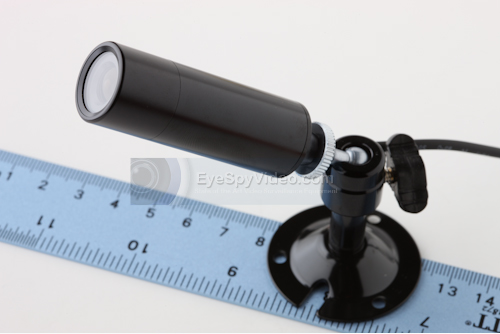
- The new CC-5XDWDR Color Weatherproof Bullet Camera has incredibly clear 700 TV lines of resolution, Digital Wide Dynamic Range and 2D Digital Noise Reduction.
- The wide dynamic range (WDR) function of a camera is intended to provide clear images even under extreme light circumstances where intensity of illumination can vary excessively, namely when there are both very bright and very dark areas simultaneously in the field of view of the camera. WDR enables the capture and display of both bright and dark areas in the same frame, in a way that there are details in both areas, i.e. bright areas are not saturated, and dark areas are not too dark. It also offers amazing low light capability.
- Digital Noise refers to the random dot pattern that is superimposed on the picture as a result of electronic noise; the 'snow' that is similar to what can be seen with poor (analog) television reception or on VHS tapes. The Digital Noise Reduction feature reduces that "noise" from the cctv camera image.
- This is the best bullet camera we have seen in terms of performance.
- If you are installing a new system or upgrading an existing one this would be the best choice. It is cutting edge so you won't have to worry about having out-dated equipment 6 months from now.
- Feel free to call us at 800-568-9291 for more information.
Previous news